
Before addressing the concept of dBm (decibel-milliwatt), it is essential to understand the concept of decibel.
The decibel (dB)
The decibel (dB) is a logarithmic unit that expresses the ratio between two powers.
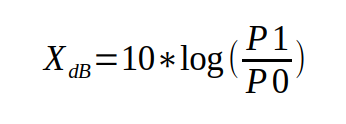
For example, if we have 2 powers P1 = 100 mW and P0 = 50 mW, the ratio between these two powers is 2, which corresponds to approximately 3 dB.
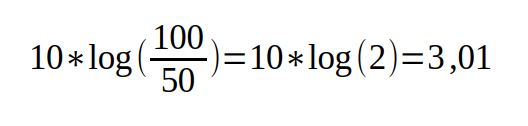
You often hear or will hear about the number -3 dB. Indeed, halving the power of a signal corresponds to a decrease of 3 dB. We say that an attenuation of -3 dB means that the signal power is divided by 2.
The decibel-milliwatt (dBm)
The dBm (decibel-milliwatt) is a unit used to measure the power of an electrical signal, with 1 milliwatt (mW) as a fixed reference.
This unit is widely used to measure the power of mobile signals (3G/4G/5G, Wi-Fi, LoRa, etc.) to ensure good reception and optimal performance.
For example, on Linux, the iwconfig command displays information about your Wi-Fi connection (WLP45S0 Wi-Fi network card in this example). The received signal strength is shown to be -63 dBm.
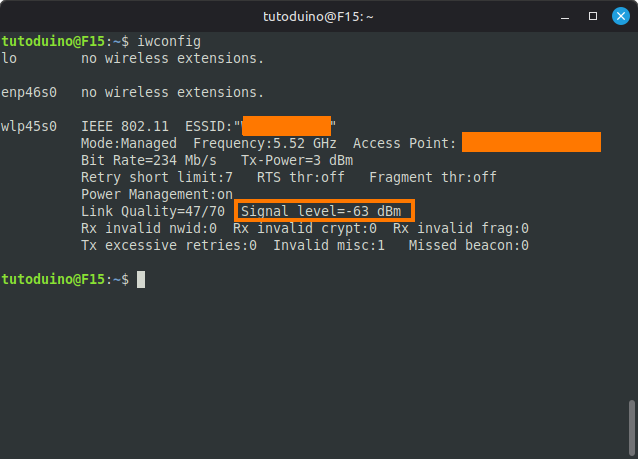
My PC is receiving a good quality Wi-Fi signal (-63 dBm), allowing for a high speed (234 Mbps).
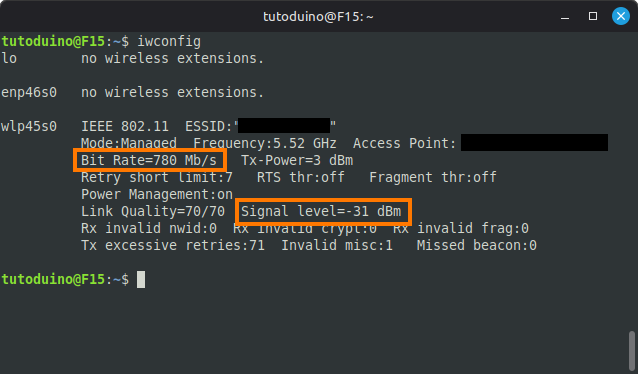
When I move my PC closer to my internet router, the signal is much better (-31 dBm), resulting in even higher speeds. Conversely, the signal becomes poor (-80 dBm) when I move my PC further away, and the speed drops to 6.5 Mbps.
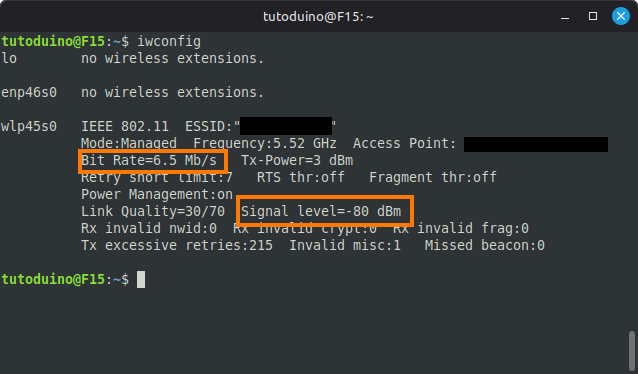
Here are some examples of received signal strength and their interpretation:
| Signal strength received | Interpretation |
|---|---|
| -30 dBm | Very strong signal, guaranteeing an excellent connection |
| -50 dBm | Excellent signal, suitable for most demanding uses (streaming, etc.) |
| -65 dBm | Acceptable signal for a stable and reliable connection |
| -90 dBm | Very weak signal, not allowing for a stable connection |
You can see that the distance between the transmitter and the receiver plays a considerable role in the strength of the received signal. Indeed, the power loss varies with the square of the distance. Therefore, doubling the distance between the transmitter and the receiver reduces the received power by a factor of four. This loss also depends on the signal frequency.
Example of calculating the reception power of a Wi-Fi signal
Consider a Wi-Fi router placed 10 meters away from my computer, transmitting on the 2.4 GHz band.
The loss related to distance is expressed in dB and is calculated using the Free Space Path Loss (FSPL) formula:
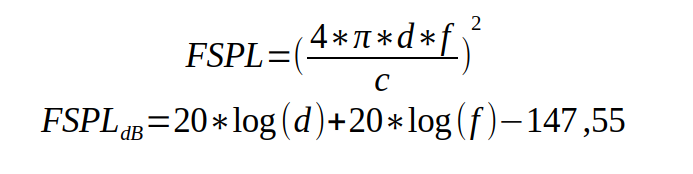
with d = distance in meters; f = signal frequency in hertz; c = speed of light in meters per second
Applying this formula, we calculate a loss of -60 dB for a distance of 10 m with a frequency of 2400000000 Hz.
The Livebox’s transmission power is 100 mW, or +20 dBm. Indeed, PdB = 10 * log(100 mW / 1 mW) = 10 * 2 = 20 dBm.
The signal at arrival will therefore be -40 dBm (+20dBm – 60 dB).
You will find on the sosh.fr website examples of attenuation related to materials (plaster partition = -7 dB, load-bearing wall = -15 dB…).
[…] indicates the strength of the received WiFi signal by the ESP32-C5. As I explain in my article What is… a dBm RSSI is measured in dBm (decibel-milliwatt). Lower values (e.g., -70 dBm) indicate a weaker signal, […]
[…] The strength of the received Wi‑Fi signal has a direct impact on the maximum throughput you can achieve: a weak signal forces the link to use slower, more robust modulation schemes and generates more retransmissions, which reduces your effective data rate. A good antenna, correctly tuned to your Wi‑Fi band (2.4 or 5 GHz), helps concentrate energy where you need it and improves both range and throughput for the same transmit power. If you want to better understand how signal power is expressed, you can read my article “What is… a dBm?”. […]